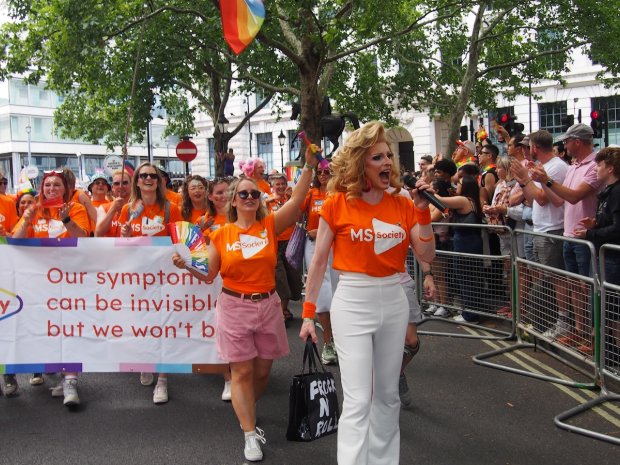
“Our symptoms can be invisible, but we won’t be”
Kev Grogan, better known as drag queen Veronica Green, marched with us at this year’s Pride in London. In his blog, he talks about visibility as someone LGBTQIA+ living with MS, gratitude and giving back.
I consider myself lucky, although I experience MS symptoms every day, I’m still able to work – to perform.
My symptoms are virtually invisible to anyone looking at me. But I get random bouts of fatigue, so I’m often taking naps in the day. Brain fog moments will have me searching for a word mid-sentence, despite it being on the tip of my tongue.
I have neuropathic pain in my hands and feet which can fluctuate from mild to incredibly strong. There’s seemingly no pattern to when it’s going to be at its strongest each day.
I also struggle with changes in temperature, both hot and cold affect my MS. In cold weather I’ll need to stop multiple times to catch my breath simply from walking.
My MS diagnosis
I was diagnosed with relapsing remitting MS in August 2024 after spending 2 weeks in hospital.
Six days before I took myself to hospital my whole body went numb. It started with tingles in my hands and feet, moving up to my arms and legs and then my torso. Once I could no longer feel my bladder and bowel functions, I knew I had to go to hospital.
Diagnosis was slow, I was seen by a different doctor every day for the first 10 days. I had all kinds of blood tests done to check for many possible causes of my symptoms. I needed several brain and spine scans and a lumbar puncture before I was formally diagnosed.
By the time I was diagnosed I couldn't use my hands, my arms were very weak and I could barely walk. It wasn’t clear if I’d get my mobility back. I was just in shock. It took time to build the mental strength to accept this could be my new way of living for the rest of my life.
Being seen and giving back
For two months after my diagnosis, I was completely dependent on my partner, Steve. He fed, clothed and bathed me while I couldn’t use my hands.
As time went by, my symptoms slowly improved and were more manageable. Once my motor functions returned I was able to work again, although I struggled with energy levels.
As soon as I knew my hand functions were coming back, I decided I wanted to go public.
Living openly
I was a bit of a late bloomer coming out as gay. I pretty much left it until the very last moment possible to tell my mum and dad. I supposed this shaped my attitude on openness and honesty on the whole. I hated suppressing my feelings or hiding who I was and when I finally came out a huge burden was lifted.
Ever since, I’ve been able to freely express myself and I’d say this is why I’m so open and honest about everything. I’ve spoken publicly about mental health when I suffered with depression and now about my MS diagnosis too. Plus, I wanted to spread awareness. MS is misunderstood and not widely known.
Marching with the MS Society in Pride
The LGBTQIA+ community has always been supportive and provided a voice and visibility for those who are oppressed or face societal challenges. I’d been an out and proud gay man for 20 years before my MS diagnosis. The community supported me for my career and for my MS diagnosis.
My fans have been 100% supportive. I speak to a lot of people about my own struggles and in turn I have a fan base that connects with me through their own experiences.
Two months after going public with MS, I was approached by the Crawley Pride organisers. They wanted to offer me work if I could do it, they wanted to help.
Being on Drag Race UK catapulted me into being a public figure and the experience has been life changing. I’ve met so many people from all walks of life who saw me as a role model and related to my struggles because I’d talked so openly about them. If I’d hidden behind the persona I wouldn’t have met and inspired so many people to speak freely about MS and mental health issues. So, in that respect, being ultra visible came with a kind of responsibility.
So, marching in London Pride with the MS Society is about giving back and helping everyone be seen. That’s why we chose our banner slogan this year, “Our symptoms can be invisible, but we won’t be.”


