Finding hope when my world felt locked down
In 2008, we funded researchers at Coventry University to run a small, early-stage trial of a new self-management programme for people with MS. While a larger-scale trial is still in planning, more than 500 people with MS have completed the Hope Programme. Bethan, who lives with relapsing MS, tells us about her experience.
I was diagnosed with MS in 2018. Those first few years were tough and trying to get my head around the diagnosis was all-consuming.
My world shrank and life felt very small. I was stuck indoors, isolated and scared. I spent a lot of time focusing on every symptom and worrying about what the future might look like.
I went on the online Hope Programme in March 2020. When everyone else’s worlds were starting to lock down because of COVID-19, my world began to open up. Being online was great, it was something I could do at home, at my own pace.
Meeting people who truly understood
When I joined the Hope Programme, for the first time I was meeting other people with MS. People who really got it, because they’d worn the same shoes I was wearing. And actually, that felt quite life-changing.
We were all so different, as you are with MS. But we all understood and I felt less alone. I found the power of that quite incredible.
My time capsule of hope
Each week we explored different topics. I learnt more about MS. I came away with tools to take better care of me. Goal setting enabled me to try new things.
We were encouraged to share something that might have made us smile, given us comfort, or brought us a little bit of joy.
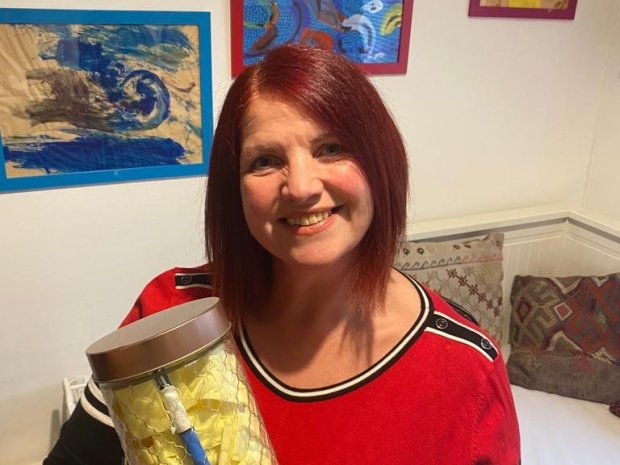
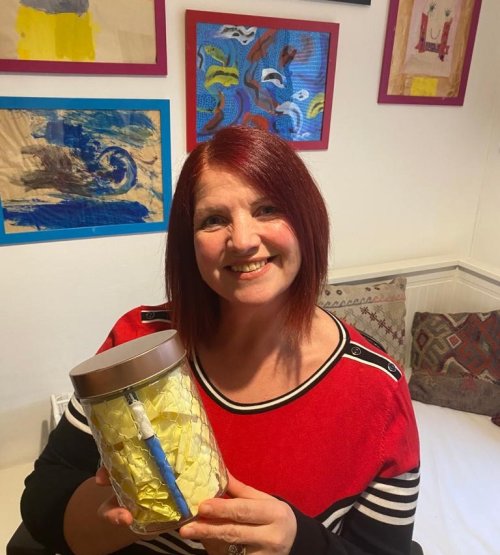
Now I have a gratitude jar, my little time capsule of hope, filled with mindful moments. Each one reminds me that even on hard days, there is still something good to hold on to.
Now I have a gratitude jar, my little time capsule of hope, filled with mindful moments. Each one reminds me that even on hard days, there is still something good to hold on to.
Focusing on what I can do
For me, it really felt like the Hope Programme helped me turn a corner. Before, my thought processes were pretty negative. Now, I think more positively and focus on what I can do. I know I might have to do things a bit differently, but different is good.
I’m back, I feel more in control and able to do more of what I want to do, with amazing support from wonderful people all around me.
The impact on my family
The change has had a ripple effect on my family too. My daughter who was 13 when I was diagnosed, decided to raise awareness by focusing her A-Level textiles project on my experience of living with MS.
She chose the word “trapped”, because that’s how I felt before the Hope Programme. Trapped in my home and in my new MS body and world.
She took that one word and designed beautiful garments with meaning, inspired by it.
Take a look at some of the garments on the Hope website
Opening new doors
Not only did I find hope through the programme, but I’ve also given hope back. I became a facilitator, supporting on the Hope Programme.
Over time, that grew into something I never imagined. I’m now employed by the social enterprise that runs the Hope Programme. I help train and support others to facilitate the course.
After my diagnosis, I genuinely thought I’d never work again. How wrong was I.
I got a lot more than I bargained for when I thought I’d give the Hope Programme a try, but it’s the best thing that could have happened to me.
Find out more about the Hope Programme for MS on their website
The Hope Programme is a free six-week online course, delivered by Hope For The Community CIC. Courses run throughout the year. The next course starts on September 23rd 2026.
Read about the original MS Society-funded trial of the Hope Programme on the journal website
You may be interested in


Join the Research Network
Our Research Network make sure all the research we fund reflects the needs and interests of people living with MS. And they help us talk about it in a way that’s accessible to everyone.
Anyone who lives with MS or cares for someone who does can get involved. It doesn't matter where in the UK you live or how much research experience you have.
