MS Society Cambridge Centre for Myelin Repair
Background
There are now over twenty disease-modifying therapies for people with relapsing MS, and some emerging for people with progressive MS. But they don’t fully prevent progression. This is because they only work on one part of the problem: reducing inflammation.
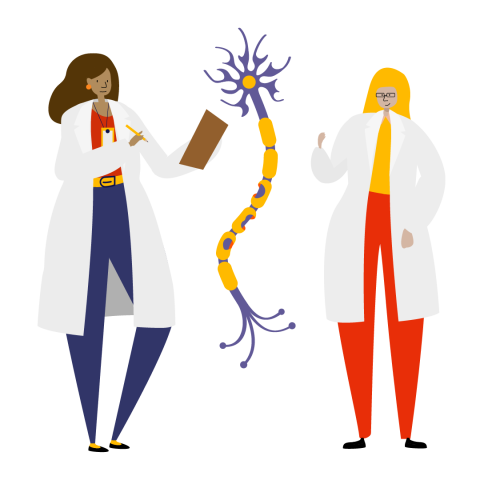
We need treatments that can protect nerves that are still healthy from dying, by repairing the myelin wrapping that gets damaged in MS.
The brain does contain stem cells called oligodendrocyte precursor cells (OPCs) that can repair this damage. But OPCs become less effective with age, and in MS. The Centre aims to:
- understand why OPCs stop working, through basic research in labs and animal models
- identify treatments that can put myelin back on nerves
- test these treatments in animals and people with MS.
The Centre has already run two small but successful trials with people with MS: the bexarotene trial (CCMR1) and the metformin and clemastine trial (CCMR2).
Over the next five years, Professors Thora Karadottir, Stefano Pluchino and Alasdair Coles and their team, will build on this progress to advance key discoveries and drive these towards a step-change in our understanding, and ultimately treatment, of MS.
About the project
The team will continue to explore the biological mechanisms of myelin repair. And identify factors that drive or block myelin repair and MS progression. They’ll investigate how ageing, genetics, and inflammation disrupt the myelin repair process. And how these effects might be reversed.
This programme will be led by a team of internationally-recognised experts, supported by a network of global collaborators. They’ll continue to focus on building capacity in both new technologies and people. To launch the next generation of MS research leaders and position the Centre at the forefront of the development of urgently-needed treatments.
Their work is focused on three themes:
- Why do OPCs fail to repair myelin in people with MS?
From their previous work, the researchers know there are cells in the brains of people with MS that actively prevent the stem cells from putting myelin back on nerves.
These are cells that normally provide nourishment and support to nerve cells: astrocytes. And cells that clear up debris in the brain: microglia. Unfortunately, something about MS changes the behaviour of these cells, and they contribute to the damage.
The team will try to understand why these cells change and what might be done to turn them back to a healthy state.
- What determines the variation in myelin repair and nerve cell damage amongst people with MS?
In this theme, the team are developing a toolkit of experimental models, using human cells and new animal models of progressive MS. These models will help them test theories of how myelin repair works, and what upsets it.
The toolkit will include for example, making 3D “mini-brains” where stem cells create all the organised layers of cells found in the healthy human brain. They’ll apply stressors to these mini-brains, to mimic MS.
Once they’ve established how damage occurs in these different models, they can apply drugs to see which help.
- How can we best identify myelin repair in people with MS?
There's no agreement yet on the best tests to use in trials of myelin repair, to show that the stem cells have wrapped new myelin around nerve fibres.
Current contenders are tests of the speed of vision and advanced MRI scanning. The team are investigating these, and exploring new potential measures, such as special blood tests.
They’ll also investigate whether myelin repair in people with MS, does actually prevent nerves from becoming damaged and dying.
How will it help people with MS?
The overarching goal of the Cambridge Centre for Myelin Research is to discover new treatments that stop people with MS from developing permanent disability.
They hope this next programme of work will lead to more clinical trials and ultimately licensed treatments.
If therapies promoting myelin repair can stop, or one day even reverse, disability associated with MS progression, the team hope that, in the future, anyone diagnosed with MS will receive both a DMT and a myelin repair treatment that’ll work together to prevent disability.
You may also be interested in