
Behind the logo: The power of lived experience at the MS Society
For Disability History Month, we’re celebrating the contributions of disabled people and exploring how lived experience can shape organisations to be more inclusive.
We spoke with Beth Grimsey and Clare Cowen, two of our colleagues who both live with MS. They share how their personal journeys led them here and how their lived experience shapes their work.
How did you come to work at the MS Society?
Clare: “I first came across the MS Society when I was diagnosed at the beginning of 2021. I followed the charity on social media. And then a couple of years ago, I replied to an Instagram story asking for feedback on the website redesign. That was my first real interaction!”
Beth: “Working here was a complete surprise. I’d been in academia for years - I did a microbiology PhD and always imagined staying in the lab. But in 2021, I had Transverse Myelitis (TM), a neurological condition caused by inflammation of the spinal cord. I was put on immunosuppressants, which meant I couldn’t safely work with certain bacteria in the lab. I left my job with nothing lined up.
Then I stumbled across this maternity cover contract for a Research Programme Manager. I applied, thinking, ‘Why not?’.
The weirdest coincidence - I had my formal MS diagnosis the day before I started working here. Now I’ve been here three and a half years!”
Clare: "It’s amazing how things line up. While I was interviewing for my role as Digital Services Product Manager, I was also helping in a volunteer role with a press release about expanding access to cladribine (Mavenclad). It suddenly felt like everything was connecting.”
How does your lived experience shape what you do at work?
I am my own audience.
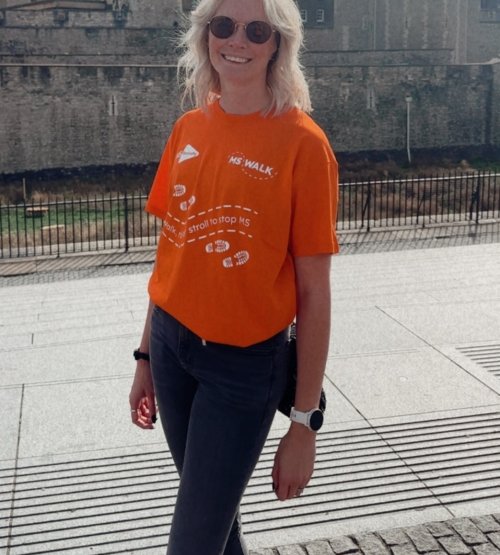
Clare: “I look after the digital services that support our community. Like our Forum, the email journey for people who are newly diagnosed, and our disease modifying treatment (DMT) decision tool. I’m always thinking about what people actually need and how we evolve our support.
In my interview, I said, ‘I am my own audience’. Everyone's MS is different, but I think it’s bringing that audience lens into digital product management that really matters.”
Beth: “As Research Programme Manager, I look after big pieces of our research infrastructure, like the UK MS Register, Octopus Trial, the Tissue Bank, the Edinburgh Centre for MS Research and the Cambridge Centre for Myelin Repair.
At the moment, my favourite thing I’m working on is with the Treatment Advisory Committee, who are a group of people looking at potential drugs for the next arm of the Octopus Trial. My PhD was on repurposing drugs for antibiotic resistance, and now here I am, looking at repurposing drugs for MS. Full circle!
I had a moment in a meeting discussing potential treatments where I took a step back and thought, ‘wow, I'm helping shape research on medications I might take one day’. It was strange, suddenly realising I'm both inside the process and, at the same time, someone who might benefit from its outcome.”
Clare: “I think that’s what makes working here so special and kind of harmonious in a way. We have these personal connections to our own work and objectives.”
I want people on Newly Diagnosed Days to see that life with MS isn’t always as scary as it first seems.
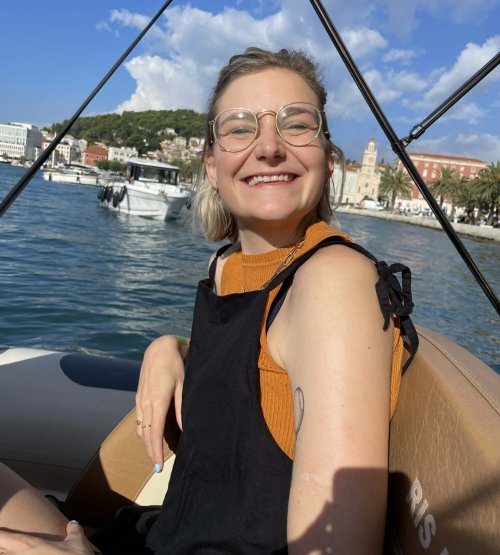
Beth: “Part of my job is to share the research we fund with our community at events like our Information Days and Newly Diagnosed Days. At those events, I always tell people I have MS, and what often strikes me is how important it can be for people to see someone who’s living and navigating life well.
Through my role, I meet people who have taken part in research, knowing that it might not directly benefit them, but it could help people like me. I hope that, through the work I do here, I can also give something back to the community for future generations."
Could you tell us more about the MS Society’s Purple Network?
Beth: “The Purple Network is our staff-led space for our disabled colleagues and those with long-term physical or mental health conditions. We meet monthly, we check in, laugh, and rant a bit. And we bring lived experience into HR (human resources) consultations and wider conversations.”
Clare: “When I joined this April, the first thing I did was look for staff networks. I was looking for a space where I could socialise with people like me. The Purple Network is a safe space. People share things like Access Card recommendations, or how they navigated a reasonable adjustments request. We support each other through things we all understand.”
Beth: “And the organisation listens. We're often asked to feed into different things that are happening and to ensure the voices of disabled staff are heard. When our feedback is used to make changes, I feel really proud.
We’re only a small percentage of the organisation, but our voices can protect so many colleagues – not just those with disabilities, but also people who have caring responsibilities or who are going through fertility treatment or pregnancy care, too.”
How does working here affect you outside of work?
Beth: “The healthcare system tries to look after you, but navigating it with MS is so hard. MRIs, medication deliveries, healthcare appointments… nothing is ever simple. You need to be able to advocate for yourself, or have someone who can, otherwise things can slip through the cracks.
Working here has given me the confidence to push for better care for me and challenge things when they don’t feel right, to say ‘no, actually, this doesn’t work for me.’ But that shouldn’t be a privilege. It shouldn’t depend on who you know, where you live, or your ability to navigate the health care system. And the fact it so often does makes me really angry.”
Clare: “Absolutely! And you’re the only one who really knows what you need. A nurse, or even a manager, can only help if you’re honest with them.
Early on, I was embarrassed to talk about certain symptoms with my MS nurse. But working here, with people who really understand, has made me more open.
Now I’m like: ‘This is what I need. This is how you can help.’ That’s been huge for me."
What have been some of your favourite MS Society moments?
Clare: “Doing my first MS Walk in London this year, with my husband, was really emotional. Seeing a sea of orange T-shirts, hearing strangers cheer, crossing that finish line and getting the medal. It all felt like I was making a difference beyond my day job.
It was also the first time I’d taken part in something physically active for MS, and I shared my story on social media for sponsorship. That was really special.”
Beth: “The MS Walk was special for me, too. My parents, my wife, and my friends all walked with me.
But my favourite moment was at the Cambridge Centre for Myelin Repair annual Symposium, which is a two-day event where researchers meet to discuss all things myelin. I mentioned in my talk that I have MS. Afterwards, an attendee came up to me, she also has MS but hadn’t told anyone she works with. She asked how I felt about being so open.
I told her I overwhelmingly love my job and the people I work with, and that being open has been a really positive experience for me.
She said she was going to share her diagnosis with her colleagues and knowing I might have played a small part in giving her the confidence to do that meant an awful lot.”
How do you feel about working here overall?
Clare: “I don’t think people realise how many staff behind the logo have personal connections to MS. On my first day, I was asked what my connection to MS was, and I decided to be honest, and suddenly, all these people were telling me theirs. I felt instantly part of something.
I noticed that people genuinely cared about the people and our purpose... even small actions like making sure how information is sent ahead of meetings is accessible.”
Beth: “It’s true! People with MS are at the heart of everything we do. We care deeply about the community, and about each other.
Every day, people in this organisation wake up, open their laptops, and do this work because they really want to make a difference.”
Everything we do is driven by one motivation: to help people within the MS community live better with MS, whether through research, services, or day-to-day support. We're all working together towards that same powerful goal.
Clare
About Disability History Month
Disability History Month reminds us that every action, from inclusive policies to staff networks, is part of a wider struggle for equality and recognition for all disabled people.
Clare: “For me, Disability History Month is about recognising that my story is a small part of what people experience in their day-to-day. It’s a time to learn about the lives of others and share in the awareness of their journey.
It’s also a chance to celebrate the achievements and contributions of those within this special community. How individuals have advocated, shared stories and taken part in research to help others live well with their own diagnosis.”
Beth: "Yeah, as you say, it's about celebrating achievements and taking a moment to reflect on how far we’ve come, but also on how much work is left to do.
The current political climate is challenging for disabled people, with ongoing cuts to social care, pressure on the NHS, and challenges accessing support. That’s why Disability History Month feels especially important now, and why speaking up, sharing our stories, and pushing for change matters so much.”
You may also be interested in


Interested in working with us?
At the MS Society, we make sure people living with MS are at the centre of everything we do. And it’s this commitment that unites us across the UK.
Our people are our greatest asset and the key to our success. We offer a vibrant, progressive environment where you will make a difference for everyone effected by MS. Together we can stop MS.
