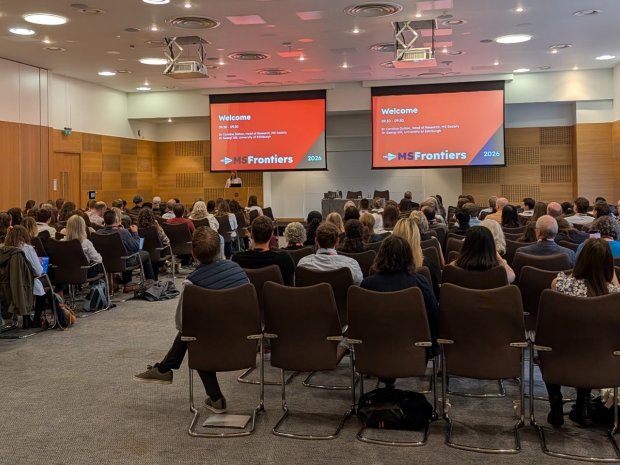
MS Frontiers 2026 through the eyes of a PhD student
As a PhD student, conferences can feel like stepping into a busy map of the research world. There are familiar landmarks, new routes and acronyms that make you wish you had packed a dictionary. But MS Frontiers 2026 felt different. It was scientifically rich, but also welcoming, practical and centred on one of the questions that matters most: how can research make life better for people living with MS?
One of the things I enjoyed most was the mix of voices throughout the event. Early career researchers, professors, clinicians and people from different disciplines all had space in flash talks, oral presentations and poster sessions. This gave the conference an energy that felt collaborative rather than hierarchical. As someone early in my research career, it was encouraging to see knowledge presented as something built through conversation.
Here were my two main takeaways:
Doing research with traditionally under-researched groups
One of the strongest messages I took away was the importance that the MS Society placed on patient and public involvement (PPI), and on equality, equity, diversity and inclusion (EEDI). These were not treated as “extra” themes at the edge of the programme. They were woven through discussions about how research questions are chosen, how studies are designed, and how findings should be shared.
What was striking was that this wasn’t a surface-level discussion where we simply recognised that diverse voices need to be heard. There was also space to reflect on practical ways we can reach previously under-researched communities and make sure a wider range of lived experiences shapes MS research.
This came through in examples such as the co-production of interventions like REFUEL-MS and Navigate MS. It also appeared in the way research was shared, including lay summaries of published work written by people living with MS. Another memorable example was Dr Georgi Gill’s poeMS project, where people with MS write poems about their own experiences, offering a powerful and creative way to communicate what living with MS can feel like. These examples were powerful reminders that good research is not only about the methods we use or the results we produce. It is also about who is involved, whose experiences are valued, and whether the end result is meaningful in real life.
Answering the “so what?”
Another theme that stood out was the clear focus on impact and translation. Presenters were encouraged to answer the “why should I care?” question. Why does this finding matter? What could it change? How might it help someone living with MS now or in the future?
This resonated strongly with me as a health psychology researcher. My own work focuses on evidence-based psychological support for people living with MS, particularly the distress that can understandably arise from constantly adjusting and re-adjusting to changes in symptoms, roles, identity, and uncertainty. At MS Frontiers, I was inspired by work showing how this can be translated into support for specific moments and symptoms in people’s lives.
Imogen Collier’s oral presentation on menopause and women’s mental health highlighted how significant life events can shape experiences of MS in ways that need to be better understood and supported. Elisa Nedelec’s poster on digital interventions for tracking menstrual-cycle-related changes in MS symptoms also showed how research can become more practical and responsive to the patterns people notice in everyday life.
I was also struck by poster presentations exploring psychological interventions for invisible symptoms, including sexual difficulties by Emily White, pain by Goretti Hurtado Barbeito, and fatigue by Hannah Proudfoot and Ereza Ibrahimi. These presentations were powerful because they moved beyond simply describing difficulties. Instead, they highlighted support that could be targeted, acceptable, and useful for people living with symptoms that are often hidden, under-discussed, or difficult to manage alone.
For me, this was impact and translation in action: taking research evidence and asking how it can become tools, interventions and conversations that make a difference beyond the conference room.
My final reflection
I left MS Frontiers 2026 feeling energised, knowing that MS research is moving towards being more inclusive, more practical, more creative and more connected to the real experiences of people living with MS. For a PhD student, it was a reminder of why research matters, and of the kind of research community I want to be part of.
You might also be interested in


Join the Research Network
Our Research Network make sure all the research we fund reflects the needs and interests of people living with MS. And they help us talk about it in a way that’s accessible to everyone.
Anyone who lives with MS or cares for someone who does can get involved. It doesn't matter where in the UK you live or how much research experience you have.
