Climbing high to raise vital funds
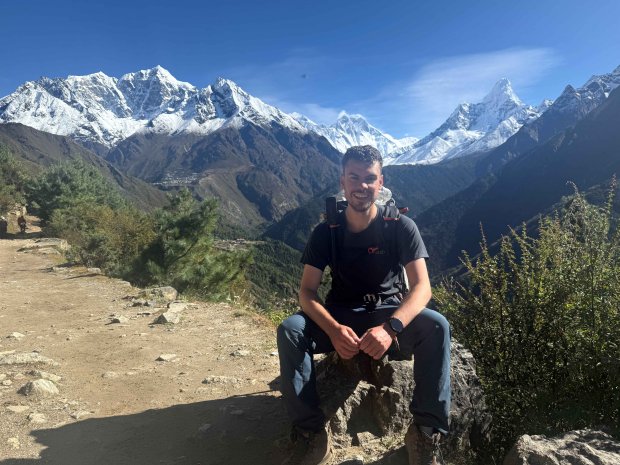
Alan's been fundraising for us for over a decade, raising around £80,000 through endurance challenges. He tells us about conquering Manaslu in Nepal — the world’s eighth highest mountain (8,163m).
I’m 29 and come from the Scottish Highlands. I work in the Merchant Navy and NorthLink Ferries as a Deck Officer. My mum was diagnosed with primary progressive MS in 2011. As her health declined, she had to give up work as a Highland Dance teacher, but has started her own crafts business. Her continued commitment not to just give up hope has inspired me to dig deep in my endurance challenges.
I grew up watching the London Marathon with my mum every year on the TV. I’ve always been into sport, especially football. When I joined the Merchant Navy I had three years of training in Glasgow, and started running to keep fit.
Mind over matter
My first challenge was the Edinburgh Marathon in 2016. I’ve now completed 25 marathons, including four of the World Majors (Berlin, Chicago, London and New York). The dream is completing all the World Majors — with Boston and Tokyo still to go.
I have a good general base fitness. But I work away a lot, which makes it harder to follow training and nutrition plans. So I have to dig deep and use my mental strength to get through my challenges. Mind over matter.
Two Scottish boys
I met my friend Calum climbing Mount Kilimanjaro in 2018. He’s from Glasgow and his mum also has MS. Being the two Scottish boys, we were put together as tent buddies. We’ve been very good friends ever since, and had lots of conversations about climbing an 8,000m mountain. We finally decided 2025 would be the year and, after hours of research, Calum picked Manaslu.
Training wise, I tried to climb as many Munros (Scottish mountains over 900m) as I could, including a couple in winter conditions to get used to wearing big boots and crampons. I think I’ll do a lot more back pack training for the next one.
Getting acclimatised
Manaslu Circuit is one of the most scenic circuits in Nepal. One side has a rocky Arctic tundra feel to it, while the other is green and lush with fast- flowing rivers. We spent three weeks at base camp 4,900m up and did two rotations (climbing to higher camps to adapt to decreasing oxygen levels and then descending to a lower camp to rest) before a summit push.
Between camps one and two there were two massive vertical ice walls. I had to scale these using ice climbing techniques which were new to me, but I adapted very quickly. Camp three to camp four was 10.5 hours of step climbing and my first time on oxygen.
Sticking together
We were a team of six, plus one-on-one Sherpas for the later part of the expedition. The work and commitment the Sherpas put in at such high altitudes is nothing short of amazing. We were all there for our own reasons, but we stuck together and spurred each other on.
We were very lucky with the weather, which was perfect. The ice walls got easier as I gained confidence with new techniques.
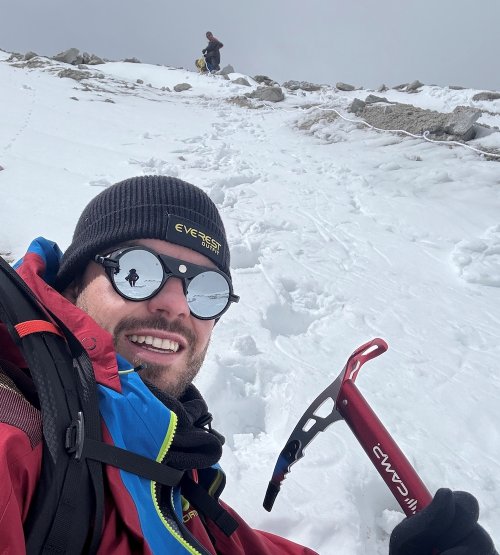
Each rotation helped but the altitude was still tough going. We were always secured safely into the fixed lines when traversing over sheer drops and climbing the vertical ice walls. There were a couple of hairy moments on the second mountain — but the less said in front of Mum, the better.
Digging deep
I expected the climb to be tough and knew I’d have to dig deep. But I grew in confidence as the trip went on. Crossing the crevasse on ladders for the first time after seeing them online was certainly a daunting experience! But the views were never ending, and spectacular in every direction. I’d say it looks like Scotland, but the mountains are ginormous in comparison.
The worst part was actually eating the dehydrated meals. The taste and texture were terrible. But I needed to eat for energy, so forced the food down as best I could.
On the summit push we had a night at each camp and then left camp four at 3am, reaching the summit at 8am on 25 September 2025.
A sense of doing good
My next expedition will take me to the world’s fifth-highest mountain, Makalu (8,485m). It’s one of the most technically demanding 8,000m peaks on earth. Only 16 UK citizens have summited since it was first achieved in 1955.
I may run marathons and climb mountains, but all fundraising, whatever the scale, is welcomed by the MS Society. It’s about raising awareness as well as funds, and gives you a sense of doing good.
I’ve experienced the benefits of fundraising by seeing my mum take part in clinical trials. They may not help her, but will hopefully help those diagnosed with MS in the future.
You may also be interested in


Share your story
Just like MS, every MS story is unique.
We'd love to hear about your MS stories, from diagnosis to how you told loved ones and employers. Maybe you have found an interesting way to manage your symptoms or want to tell us about the challenges you have faced?
We're always on the look out for stories about life with MS to share with the community. So get in touch.
