#BehindTheTrials: The people making research into progressive MS possible
In this edition of our #BehindTheTrials series, we catch up with three people working to make the Octopus and ChariotMS trials a success.
Dr Tarunya Arun
Dr Tarunya Arun is a Consultant Neurologist and researcher dedicated to stopping MS. She told us about why clinical trials are so important:
Every clinic visit is a reminder of the challenges people face day to day, particularly those living with progressive MS where treatment options remain so limited. Hearing directly from patients about what matters most to them – whether that is maintaining mobility, preserving hand function, or being able to stay independent for longer – helps shape the priorities of my research.
As a neurologist specialising in MS, my work with patients is central to everything I do.

ChariotMS and Octopus are both trials focused on progressive MS. That’s important because people with progressive MS currently don’t have any treatments to slow or stop their progression.
What makes ChariotMS particularly valuable is that it looks at hand and arm function. This means that people who use wheelchairs, people with more advanced MS, and those of older age – who are often excluded from research – can be included.
Octopus is special because of its unique design. By testing several treatments at the same time, it’s more efficient at testing potential therapies for progressive MS.
Why clinical trials are so important
Clinical trials are the only way we can move from promising ideas in the laboratory to treatments that genuinely make a difference in people’s lives. Without them, we will not know whether a new approach is safe, effective, or worth pursuing further. Every advance in care we have today exists because people took part in trials and because communities supported the research behind them.
There are still areas in MS, especially in progressive MS, where treatment options are very limited. Supporting the Stop MS Appeal, by taking part in research or through donations, helps to keep trials running and accelerates the search for therapies that can change lives.
Professor Jeremy Chataway
Professor Jeremy Chataway is a Consultant Neurologist and Octopus Trial Lead. He told us about why he's proud of what we've achieved in the last decade:
The Stop MS Appeal has been a catalyst to put progressive MS more on the map and bring everyone together. It’s been a big win for MS research in the UK and beyond. It helped us get more trials run, more infrastructure set up, and more people involved.
My biggest highlight of the Stop MS Appeal was being able to start the Octopus trial. It’s the first ever multi-arm, multi-stage trial for progressive MS. Because of its revolutionary design, we’ll be able to test treatments for progressive MS up to three times faster. We now have 16 Octopus sites open across the UK and over 575 participants have already joined the trial.
Before I retire, I really believe I'll have in my hand a medicine that really does reduce progression.

It’s been incredible to see the interest and backing from the global community. Octopus is really seen as a flagship trial in the community globally. Other conditions like Parkinson’s are using a lot of our learnings to set up their own trials with a similar design.
We have to maintain momentum
I’m very proud of what we’ve achieved so far. But we have to maintain momentum and keep MS on the map. We can’t stop until we have effective treatments for everyone with MS. I want to personally thank everyone who has supported the Stop MS Appeal so far. Your support is invaluable and trials like ChariotMS and Octopus would not be possible without you.
Tina, ChariotMS participant
Tina told us what participating meant to her:
I am 66 and was diagnosed with MS 14 years ago. Initially I was diagnosed with relapsing remitting MS. But the medication made no difference and I was slowly getting worse. So after three years my consultant changed my diagnosis to probable primary progressive MS.
It was very frustrating because there were no treatments available for me anymore. But someone in my MS team encouraged me to put myself forward for the ChariotMS trial. I decided to join because I thought: “I’ve got nothing to lose but maybe a lot to gain.”
Being part of ChariotMS brings me hope.
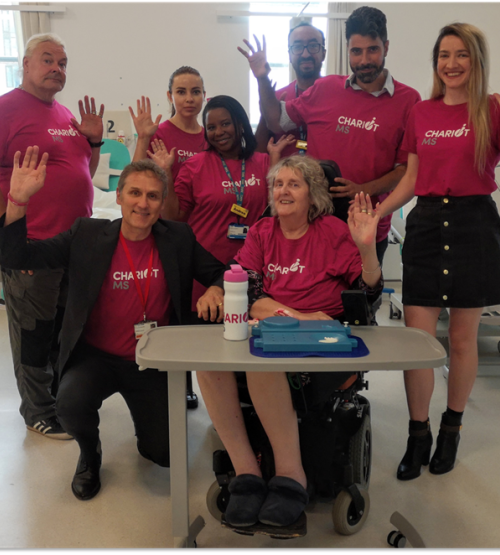
I enrolled in ChariotMS as the hundredth participant in May 2023. I felt very lucky, excited and privileged to be part of the trial. The aim of the trial is to halt MS progression. I’m hopeful that we could find something that could end up slowing down the progression of my MS. And be helpful to other people with progressive MS who currently don’t have any treatments.
I would encourage anyone who was contemplating being part of a trial to go for it. After all what have you got to lose?
You may also be interested in