Timms Review interim report: PIP no longer fit for purpose
The steering group leading the review of Personal Independence Payment (PIP), also known as the Timms Review, published its interim report today. The report has found that PIP is no longer fit for purpose and needs to change to make it fairer for disabled people
Read on to find out more about what the report says and what it means for people with MS.
What is the Timms Review?
The review is looking at the key issues with PIP. And what changes could be made to ensure it is ‘fair and fit for the future’.
The review is led by Sir Stephen Timms MP, the Minister for Social Security and Disability with co-chairs, Sharon Brennan and Dr Clenton Farqhuarson CBE. They lead a steering group made up of disability experts and disabled people with experience of claiming PIP.
The Timms Review is expected to share its recommendations for PIP with the Secretary of State for Work and Pensions by the end of 2026. The recommendations will be informed by what people share during the review. The Government will then decide what changes should be made to PIP.
What is the interim report?
The review started last autumn. Since then the steering group have been engaging with disabled people and organisations. This included a Call for Evidence which received tens of thousands of responses.
The interim report sets out what the steering group has heard so far, and what they think are the key issues with PIP. But it doesn’t make any recommendations for how PIP should be changed, as these will be included in the final report.
What does the interim report say?
The interim report has found that PIP is no longer fit for purpose. It says that a stressful assessment process fails to reflect what it’s like to be disabled.
Here are the findings which are most relevant for people living with MS.
The assessment process fails to reflect the impact of lifelong, fluctuating and invisible conditions like MS
The report says that many believe the current assessment fails to reflect the impact of living with fluctuating, cumulative and less visible conditions, like MS. It raises issues such as:
- the application form is widely perceived to be long and very difficult to complete, particularly for people with fatigue or fluctuating conditions. Many people need help to complete it.
- people are often assessed on their ability to do tasks at all, rather than on whether they can do them reliably. And issues such as fatigue and cognitive difficulties are commonly overlooked.
- decisions are often based on how a person appeared in a ‘snapshot’ assessment. Meaning that their ability to do tasks over time is not properly considered. People’s medical evidence is sometimes given less weight than observations made in assessments.
The report also says that assessors often lack expertise in less visible conditions, meaning they can’t properly assess them.
And many view reassessments as unnecessary for permanent conditions, such as MS, and see them as causing avoidable stress and uncertainty.
Assessments are adversarial, stressful and exhausting
The report found that assessments were commonly described as adversarial and dehumanising, with personal experiences misrepresented or dismissed. Many feel that the assessment tries to fit the impact of their condition into ‘tick-boxes’.
The report found that many people find the PIP assessment process hugely stressful and exhausting. Some people say that the experience negatively impacted both their physical and mental health.
The stress and negative health impacts can affect people’s ability to effectively engage with the process. This means they may be less likely to be awarded PIP, despite being disabled.
PIP is valued as a non-means-tested cash benefit
The report found that PIP is still valued as a vital source of support by many, helping them to manage their extra costs.
People widely thought it is positive that it is non-means-tested benefit that can be claimed whether in or out of work. This means that some people use PIP to pay for support which helps them stay in work.
People also appreciate that PIP is a cash payment, meaning they can flexibly respond to their needs in a way which works best for them.
Read the full Timms interim report on the gov.uk website
Our view on the report
Our Head of Campaigns and Public Affairs, Charlotte Gill, says:
“Today’s interim report confirms what disabled people have been saying for many years - that the current PIP system is stressful and exhausting. We’ve been supporting people with MS to share their experiences as part of the Review, and they are clear in their call for a new approach based on fairness, dignity and respect.
"Over 150,000 people live with MS in the UK, with most diagnosed in their thirties and fourties. This is our chance to build a PIP system that acknowledges invisible and fluctuating symptoms, ends unnecessary reassessments, and works for everyone. But the next steps are crucial - and must continue involving and listening to disabled people. That’s the only way to make PIP fair and fit for the future."
What happens next with the review
Over the coming weeks, the Timms Review steering group will continue to gather evidence. In autumn, where they will work with disabled people and organisations to design and test recommendations for policy changes. The final report which sets out what should be changed is expected by the end of 2026.
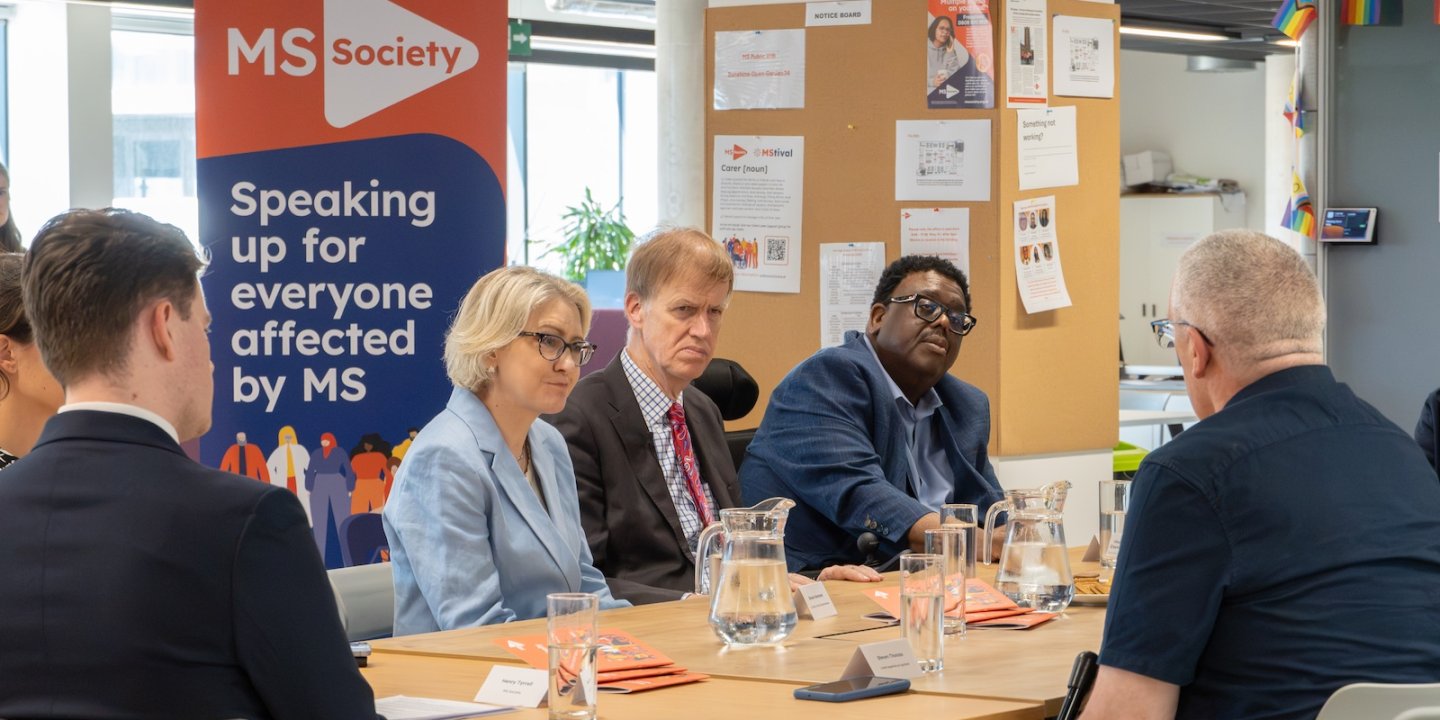
People with MS meet the Minister and Timms Review co-chairs
To coincide with the launch of the interim report, Minister Timms and co-chairs, Sharon Brennan and Clenton Farquharson, visited the MS Society office in London. They met people with MS who shared their experiences of claiming PIP.
Speakers talked of the impact that stress has on MS and how the PIP process makes this worse. They shared with the Minister how they had to fight to be understood through an assessment process that didn’t account for fluctuating and invisible symptoms. And co-chairs heard that the process was complicated, difficult for them to navigate, and that they lacked proper support.
Sian Pugh, 60 from Orpington lives with relapsing MS and has been claiming PIP for nine years. She joined the discussion to share her views with the Minister:
“It felt empowering to speak up in front of the Disability Minister today. The whole PIP experience has been completely dehumanising and demoralising, and this was our opportunity to show him the people behind the statistics. There is a strong sense that people like me are viewed as though we are trying to cheat the system - and it's so far from the truth.”
Robert, 36 from London spoke about his experience meeting Minister Timms and the Review co-chairs:
“It felt like for the first time that it’s potentially meaningful to share my experience and to have people genuinely listen to me. And also to meet others that have similar but very different experiences. Because all of our experiences are individual but there’s an overlapping theme that we’ve all struggled with the application and reassessments for PIP.”
Sign our petition to fix PIP
The Timms review is the biggest opportunity in over a decade to make PIP fairer for people with MS. We’re campaigning for PIP to be built on fairness, dignity and respect that better reflects the reality of living with MS.
Add your name to our petition today and tell the UK Government that it’s time to fix PIP.
We’re here for you
For someone to talk to right now, or any advice on benefits, our MS Help team is here for you. You can call us on 0808 800 8000 or send us an email at [email protected].
You may also be interested in