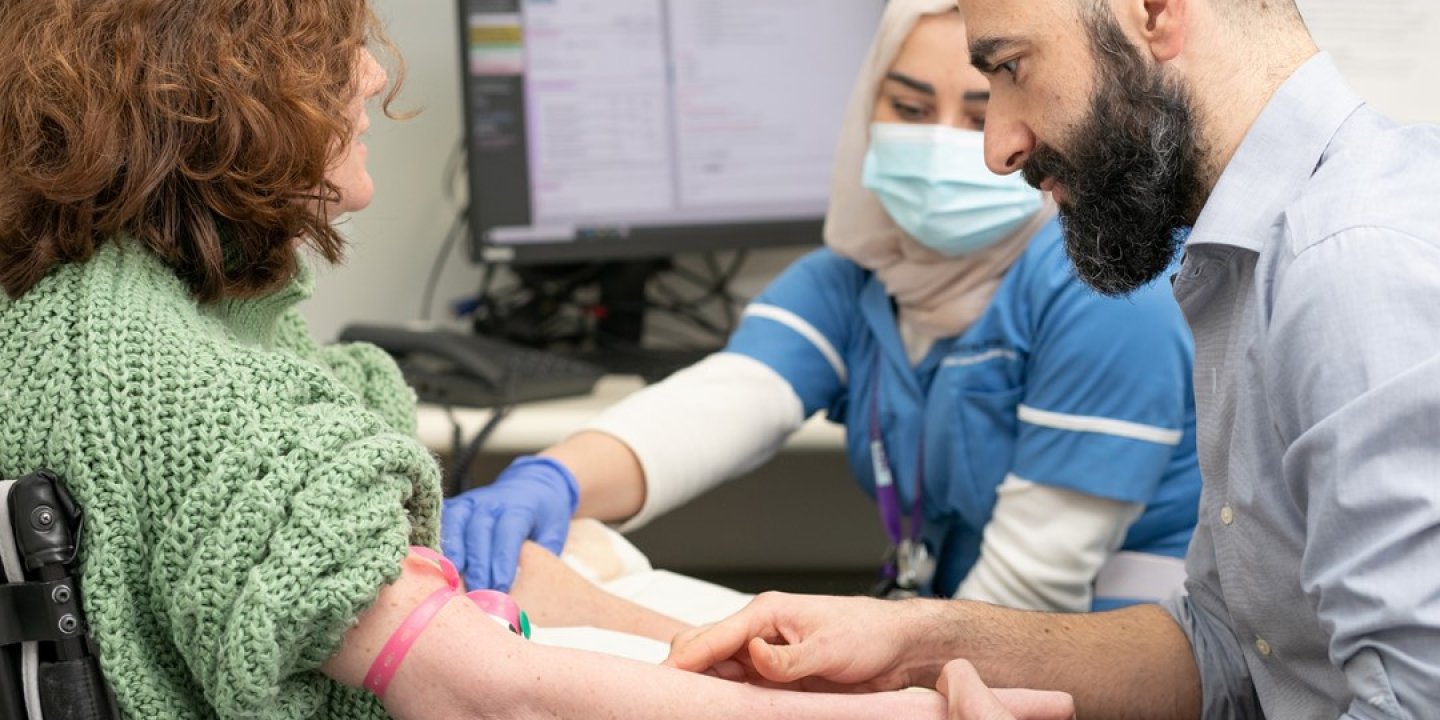
Developing blood tests to use in clinical trials for progressive MS
It can take a long time to see if a drug has an effect on disability. To speed things up, researchers look for early signs of whether a drug is working that are quicker and easier to measure.
MRI scans measure brain volume and are often used in trials. They can be a good early measure of whether a treatment is slowing down or stopping the brain shrinking. But they don't always reflect how people feel in their daily life. This means we might miss a promising treatment if we rely solely on scans.
About the project
In this project, Professor Emma Tallantyre and her team are looking for additional signals that provide early clues about whether a treatment is working. When nerve cells in the brain are damaged or stressed, they release specific proteins into the bloodstream. New technologies now allow researchers to detect and measure these proteins, known as blood biomarkers, through a simple blood test. This process only requires a small amount of blood and is quicker, cheaper and less invasive than an MRI scan.
This project aims to test whether these blood biomarkers can act as reliable early signs of whether a treatment is having a positive effect.
The team will use blood samples already collected from 175 people who took part in Stage 1 of the Octopus trial. They have samples from the start of the trial, at 6, 12 and 18 months. The team have three aims:
- To measure how the levels of six key proteins in the blood change over time in people taking part in the Octopus trial. Previous MS Society-funded research suggested that these proteins could help predict changes in disability.
- To work out which combinations of these proteins they need to measure to give the clearest picture of whether someone's MS is getting worse or staying stable. They believe that looking at patterns across several proteins will give a lot more information than just picking one.
- To compare blood test results with MRI scans to see if blood biomarkers add valuable new information that scans might be missing.
How will it help people with MS?
This work has the potential to improve how MS trials are run. It will help researchers to quickly identify which treatments are most promising (and which are not) so they can bring them to people with progressive MS sooner.


