What is MS?
Multiple sclerosis (MS) is a condition that affects nerves in your central nervous system. That's your brain and spinal cord. In MS, the coating (called myelin) that protects your nerves is damaged. This causes a range of symptoms like blurred vision and problems with how we move, think and feel.
Once diagnosed, MS stays with you for life, but treatments and specialists can help you to manage the condition and its symptoms.
More than 150,000 people in the UK have MS. In the UK people are most likely to find out they have MS in their thirties and forties. But the first signs of MS often start years earlier. Many people notice their first symptoms years before they get their diagnosis.
MS affects about two and half times as many women as men. People from many different ethnic backgrounds can get MS.
Read the latest statistics on MS in the UK
What happens when you have MS?
You can’t catch MS from someone. You get it when your immune system isn’t working properly. In MS your immune system attacks the nerves in your brain and spinal cord by mistake.
To understand what happens in multiple sclerosis, it's useful to understand a little bit about the immune system and what happens in the central nervous system.
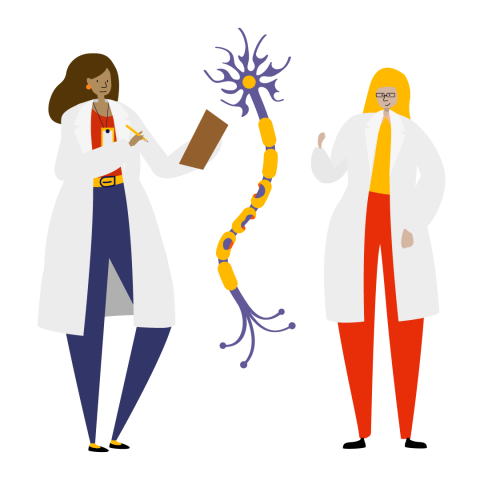
In the central nervous system, a fatty substance called myelin protects the nerve fibres. Myelin helps messages travel quickly and smoothly along the nerves in your brain, spinal cord and optic nerve (between your eye and your brain).
Your immune system fights off infections. But in MS it mistakes myelin for something that shouldn't be there, so attacks it. It damages the myelin, stripping it off the nerve fibres. This leaves scars known as lesions or plaques.
This damage disrupts messages travelling along nerve fibres. They can slow down, become distorted, or not get through at all. As well as losing the myelin, there can sometimes be damage to the actual nerve fibres too. Nerve damage can cause more lasting symptoms over time.
What causes MS symptoms?
The central nervous system controls everything your body does. So multiple sclerosis can cause many different types of symptoms. Different symptoms can happen depending on which part of your central nervous system has been affected.
Symptoms could be problems with your:
But MS is different for everyone.
Read about the first symptoms of MS
Types of MS
There are three main types of MS:
- Relapsing remitting MS, where you have relapses where symptoms get worse, then recovery periods (where your MS is “remitting”)
- Secondary progressive MS, which comes after relapsing remitting MS for many people. You’re less likely to get relapses and your symptoms are likely to get slowly but steadily worse.
- Primary progressive MS, where you get no or very few relapses. Instead, your MS progresses slowly and steadily.
Learn more about the different types of MS
Diagnosis
MS is diagnosed through a series of tests including MRI scans. It can take several months to diagnose – sometimes longer. This is because doctors will need to explore other possible causes of your symptoms.
If you think you may have MS, the first thing to do is talk to your GP.
If you’ve just been diagnosed with MS, we’re here to support you. You can call our helpline on 0808 800 8000, Monday to Friday, 9am to 7pm except bank holidays.
Read more about dealing with diagnosis
How common is multiple sclerosis?
We estimate there are over 150,000 people with MS in the UK, and each year over 7,000 people are newly diagnosed.
This means around 1 in every 400 people in the UK lives with MS, and each week around 135 people are diagnosed with MS.
In the UK people are most likely to find out they have MS in their thirties and forties. But the first signs of MS often start years earlier.
Facts about multiple sclerosis
Multiple sclerosis is a ‘neurological’ condition, meaning it affects your nerves.
‘Sclerosis’ means scarring and refers to the scars (also called lesions or plaques) that MS causes in your brain or spinal cord. These show up in magnetic resonance imaging (MRI) scans. It's ‘multiple’ sclerosis because the lesions happen in more than one place and at more than one time.
Everyone's MS is different. People can have different symptoms which come and go or continue in different ways.
Relapsing remitting MS (RRMS) is the most common type of MS. Around 85% of people with multiple sclerosis are diagnosed with relapsing remitting MS.
Once diagnosed, MS stays with you for life, but treatments and specialists can help you to manage the condition and its symptoms.
More than 150,000 people in the UK have MS. In the UK people are most likely to find out they have MS in their thirties and forties. But the first signs of MS often start years earlier. Many people notice their first symptoms years before they get their diagnosis.
MS affects about two and half times as many women as men. People from many different ethnic backgrounds can get MS.
Read the latest statistics on MS in the UK
What happens when you have MS?
You can’t catch MS from someone. You get it when your immune system isn’t working properly. In MS your immune system attacks the nerves in your brain and spinal cord by mistake.
To understand what happens in multiple sclerosis, it's useful to understand a little bit about the immune system and what happens in the central nervous system.
In the central nervous system, a fatty substance called myelin protects the nerve fibres. Myelin helps messages travel quickly and smoothly along the nerves in your brain, spinal cord and optic nerve (between your eye and your brain).
Your immune system fights off infections. But in MS it mistakes myelin for something that shouldn't be there, so attacks it. It damages the myelin, stripping it off the nerve fibres. This leaves scars known as lesions or plaques.
This damage disrupts messages travelling along nerve fibres. They can slow down, become distorted, or not get through at all. As well as losing the myelin, there can sometimes be damage to the actual nerve fibres too. Nerve damage can cause more lasting symptoms over time.
What causes MS symptoms?
The central nervous system controls everything your body does. So multiple sclerosis can cause many different types of symptoms. Different symptoms can happen depending on which part of your central nervous system has been affected.
Symptoms could be problems with your:
But MS is different for everyone.
Read about the first symptoms of MS
What is relapsing remitting multiple sclerosis?
Relapsing remitting multiple sclerosis is a type of MS where you have relapses (symptoms getting worse) followed by recovery (that’s when it’s “remitting”).
In relapsing MS, people have distinct attacks or 'relapses'. New symptoms will suddenly appear, or old ones will come back or get worse. But then these symptoms will either mostly or completely go away again.
If you don't get diagnosed with this type of MS, you might get a diagnosis instead of two other types of MS: primary progressive MS or secondary progressive MS.
Once you get a diagnosis of MS, it stays with you for life. But treatments and specialists can help you to manage your MS and its symptoms. We're here to help you live well with your MS and fund research to stop MS for good.
How common is multiple sclerosis?
We estimate there are over 150,000 people with MS in the UK, and each year over 7,000 people are newly diagnosed.
This means around 1 in every 400 people in the UK lives with MS, and each week around 135 people are diagnosed with MS.
In the UK people are most likely to find out they have MS in their thirties and forties. But the first signs of MS often start years earlier.
Facts about multiple sclerosis
Multiple sclerosis is a ‘neurological’ condition, meaning it affects your nerves.
‘Sclerosis’ means scarring and refers to the scars (also called lesions or plaques) that MS causes in your brain or spinal cord. These show up in magnetic resonance imaging (MRI) scans. It's ‘multiple’ sclerosis because the lesions happen in more than one place and at more than one time.
Everyone's MS is different. People can have different symptoms which come and go or continue in different ways.
Relapsing remitting MS (RRMS) is the most common type of MS. Around 85% of people with multiple sclerosis are diagnosed with relapsing remitting MS.
Once diagnosed, MS stays with you for life, but treatments and specialists can help you to manage the condition and its symptoms.
More than 150,000 people in the UK have MS. In the UK people are most likely to find out they have MS in their thirties and forties. But the first signs of MS often start years earlier. Many people notice their first symptoms years before they get their diagnosis.
MS affects about two and half times as many women as men. People from many different ethnic backgrounds can get MS.
Read the latest statistics on MS in the UK
What happens when you have MS?
You can’t catch MS from someone. You get it when your immune system isn’t working properly. In MS your immune system attacks the nerves in your brain and spinal cord by mistake.
To understand what happens in multiple sclerosis, it's useful to understand a little bit about the immune system and what happens in the central nervous system.
In the central nervous system, a fatty substance called myelin protects the nerve fibres. Myelin helps messages travel quickly and smoothly along the nerves in your brain, spinal cord and optic nerve (between your eye and your brain).
Your immune system fights off infections. But in MS it mistakes myelin for something that shouldn't be there, so attacks it. It damages the myelin, stripping it off the nerve fibres. This leaves scars known as lesions or plaques.
This damage disrupts messages travelling along nerve fibres. They can slow down, become distorted, or not get through at all. As well as losing the myelin, there can sometimes be damage to the actual nerve fibres too. Nerve damage can cause more lasting symptoms over time.
What causes MS symptoms?
The central nervous system controls everything your body does. So multiple sclerosis can cause many different types of symptoms. Different symptoms can happen depending on which part of your central nervous system has been affected.
Symptoms could be problems with your:
But MS is different for everyone.
Read about the first symptoms of MS.
What is secondary progressive MS?
Secondary progressive MS is a type of MS that comes after relapsing remitting MS. With relapsing remitting MS, you have relapses followed by periods of recovery. But with secondary progressive MS, you have few or no relapses. Instead, your symptoms and disability get slowly but steadily worse.
Learn more about secondary progressive MS
A third type of MS you can be diagnosed with is primary progressive MS. This is where your MS is progressive from the start.
Once you get a diagnosis of MS, it stays with you for life. But treatments and specialists can help you to manage your MS and its symptoms. We're here to help you live well with your MS and fund research to stop MS for good.
How common is multiple sclerosis?
We estimate there are over 150,000 people with MS in the UK, and each year over 7,000 people are newly diagnosed.
This means around 1 in every 400 people in the UK lives with MS, and each week around 135 people are diagnosed with MS.
In the UK people are most likely to find out they have MS in their thirties and forties. But the first signs of MS often start years earlier.
Facts about multiple sclerosis
Multiple sclerosis is a ‘neurological’ condition, meaning it affects your nerves.
‘Sclerosis’ means scarring and refers to the scars (also called lesions or plaques) that MS causes in your brain or spinal cord. These show up in magnetic resonance imaging (MRI) scans. It's ‘multiple’ sclerosis because the lesions happen in more than one place and at more than one time.
Everyone's MS is different. People can have different symptoms which come and go or continue in different ways.
Relapsing remitting MS (RRMS) is the most common type of MS. Around 85% of people with multiple sclerosis are diagnosed with relapsing remitting MS.
Once diagnosed, MS stays with you for life, but treatments and specialists can help you to manage the condition and its symptoms.
More than 150,000 people in the UK have MS. In the UK people are most likely to find out they have MS in their thirties and forties. But the first signs of MS often start years earlier. Many people notice their first symptoms years before they get their diagnosis.
MS affects about two and half times as many women as men. People from many different ethnic backgrounds can get MS.
Read the latest statistics on MS in the UK
What happens when you have MS?
You can’t catch MS from someone. You get it when your immune system isn’t working properly. In MS your immune system attacks the nerves in your brain and spinal cord by mistake.
To understand what happens in multiple sclerosis, it's useful to understand a little bit about the immune system and what happens in the central nervous system.
In the central nervous system, a fatty substance called myelin protects the nerve fibres. Myelin helps messages travel quickly and smoothly along the nerves in your brain, spinal cord and optic nerve (between your eye and your brain).
Your immune system fights off infections. But in MS it mistakes myelin for something that shouldn't be there, so attacks it. It damages the myelin, stripping it off the nerve fibres. This leaves scars known as lesions or plaques.
This damage disrupts messages travelling along nerve fibres. They can slow down, become distorted, or not get through at all. As well as losing the myelin, there can sometimes be damage to the actual nerve fibres too. Nerve damage can cause more lasting symptoms over time.
What causes MS symptoms?
The central nervous system controls everything your body does. So multiple sclerosis can cause many different types of symptoms. Different symptoms can happen depending on which part of your central nervous system has been affected.
Symptoms could be problems with your:
But MS is different for everyone.
Read about the first symptoms of MS
What is primary progressive MS?
If you have primary progressive MS, from the very first (or ‘primary’) signs of MS, your symptoms get slowly but steadily worse. This is different to relapsing remitting MS, where you have relapses and recovery periods.
The third type of MS is secondary progressive MS. This comes after relapsing remitting MS for many people.
Once you get a diagnosis of MS, it stays with you for life. But treatments and specialists can help you to manage your MS and its symptoms. We're here to help you live well with your MS and fund research to stop MS for good.
How common is multiple sclerosis?
We estimate there are over 150,000 people with MS in the UK, and each year over 7,000 people are newly diagnosed.
This means around 1 in every 400 people in the UK lives with MS, and each week around 135 people are diagnosed with MS.
In the UK people are most likely to find out they have MS in their thirties and forties. But the first signs of MS often start years earlier.
Facts about multiple sclerosis
Multiple sclerosis is a ‘neurological’ condition, meaning it affects your nerves.
‘Sclerosis’ means scarring and refers to the scars (also called lesions or plaques) that MS causes in your brain or spinal cord. These show up in magnetic resonance imaging (MRI) scans. It's ‘multiple’ sclerosis because the lesions happen in more than one place and at more than one time.
Everyone's MS is different. People can have different symptoms which come and go or continue in different ways.
Relapsing remitting MS (RRMS) is the most common type of MS. Around 85% of people with multiple sclerosis are diagnosed with relapsing remitting MS.
Once you’re diagnosed with MS, it stays with you for life. But treatments and specialists can help you to manage the condition and its symptoms.
More than 150,000 people in the UK have MS. In the UK people are most likely to find out they have MS in their thirties and forties. But the first signs of MS often start years earlier. Many people notice their first symptoms years before they get their diagnosis.
MS affects about two and half times as many women as men. People from many different ethnic backgrounds can get MS.
Read the latest statistics on MS in the UK
What happens when you have MS?
You can’t catch MS from someone. You get it when your immune system isn’t working properly. In MS your immune system attacks the nerves in your brain and spinal cord by mistake.
To understand what happens in multiple sclerosis, it's useful to understand a little bit about the immune system and what happens in the central nervous system.
In the central nervous system, a fatty substance called myelin protects the nerve fibres. Myelin helps messages travel quickly and smoothly along the nerves in your brain, spinal cord and optic nerve (between your eye and your brain).
Your immune system fights off infections. But in MS it mistakes myelin for something that shouldn't be there, so attacks it. It damages the myelin, stripping it off the nerve fibres. This leaves scars known as lesions or plaques.
This damage disrupts messages travelling along nerve fibres. They can slow down, become distorted, or not get through at all. As well as losing the myelin, there can sometimes be damage to the actual nerve fibres too. Nerve damage can cause more lasting symptoms over time.
What causes MS symptoms?
The central nervous system controls everything your body does. So multiple sclerosis can cause many different types of symptoms. Different symptoms can happen depending on which part of your central nervous system has been affected.
Symptoms could be problems with your:
But MS is different for everyone.
Read about the first symptoms of MS
What is relapsing remitting multiple sclerosis?
Relapsing remitting multiple sclerosis is a type of MS where you have relapses (symptoms getting worse) followed by recovery (that’s when it’s “remitting”).
In relapsing MS, people have distinct attacks or 'relapses'. New symptoms will suddenly appear, or old ones will come back or get worse. But then these symptoms will either mostly or completely go away again.
If you don't get diagnosed with this type of MS, you might get a diagnosis instead of two other types of MS: primary progressive MS or secondary progressive MS.
Once you get a diagnosis of MS, it stays with you for life. But treatments and specialists can help you to manage your MS and its symptoms. We're here to help you live well with your MS and research to stop MS for good.
How common is multiple sclerosis?
We estimate there are over 150,000 people with MS in the UK, and each year over 7,000 people are newly diagnosed.
This means around 1 in every 400 people in the UK lives with MS, and each week around 135 people are diagnosed with MS.
In the UK people are most likely to find out they have MS in their thirties and forties. But the first signs of MS often start years earlier.
Facts about multiple sclerosis
Multiple sclerosis is a ‘neurological’ condition, meaning it affects your nerves.
‘Sclerosis’ means scarring and refers to the scars (also called lesions or plaques) that MS causes in your brain or spinal cord. These show up in magnetic resonance imaging (MRI) scans. It's ‘multiple’ sclerosis because the lesions happen in more than one place and at more than one time.
Everyone's MS is different. People can have different symptoms which come and go or continue in different ways.
Relapsing remitting MS (RRMS) is the most common type of MS. Around 85% of people with multiple sclerosis are diagnosed with relapsing remitting MS.
Once diagnosed, MS stays with you for life, but treatments and specialists can help you to manage the condition and its symptoms.
More than 150,000 people in the UK have MS. In the UK people are most likely to find out they have MS in their thirties and forties. But the first signs of MS often start years earlier. Many people notice their first symptoms years before they get their diagnosis.
MS affects about two and half times as many women as men. People from many different ethnic backgrounds can get MS.
Read the latest statistics on MS in the UK
What happens when you have MS?
You can’t catch MS from someone. You get it when your immune system isn’t working properly. In MS your immune system attacks the nerves in your brain and spinal cord by mistake.
To understand what happens in multiple sclerosis, it's useful to understand a little bit about the immune system and what happens in the central nervous system.
In the central nervous system, a fatty substance called myelin protects the nerve fibres. Myelin helps messages travel quickly and smoothly along the nerves in your brain, spinal cord and optic nerve (between your eye and your brain).
Your immune system fights off infections. But in MS it mistakes myelin for something that shouldn't be there, so attacks it. It damages the myelin, stripping it off the nerve fibres. This leaves scars known as lesions or plaques.
This damage disrupts messages travelling along nerve fibres. They can slow down, become distorted, or not get through at all. As well as losing the myelin, there can sometimes be damage to the actual nerve fibres too. Nerve damage can cause more lasting symptoms over time.
What causes MS symptoms?
The central nervous system controls everything your body does. So multiple sclerosis can cause many different types of symptoms. Different symptoms can happen depending on which part of your central nervous system has been affected.
Symptoms could be problems with your:
But MS is different for everyone.
Read about the first symptoms of MS
What is relapsing remitting multiple sclerosis?
Relapsing remitting multiple sclerosis is a type of MS where you have relapses (symptoms getting worse) followed by recovery (that’s when it’s “remitting”).
In relapsing MS, people have distinct attacks or 'relapses'. New symptoms will suddenly appear, or old ones will come back or get worse. But then these symptoms will either mostly or completely go away again.
If you don't get diagnosed with this type of MS, you might get a diagnosis instead of two other types of MS: primary progressive MS or secondary progressive MS.
Once you get a diagnosis of MS, it stays with you for life. But treatments and specialists can help you to manage your MS and its symptoms. We're here to help you live well with your MS and fund research to stop MS for good.
How common is multiple sclerosis?
We estimate there are over 150,000 people with MS in the UK, and each year over 7,000 people are newly diagnosed.
This means around 1 in every 400 people in the UK lives with MS, and each week around 135 people are diagnosed with MS.
In the UK people are most likely to find out they have MS in their thirties and forties. But the first signs of MS often start years earlier.
Facts about multiple sclerosis
Multiple sclerosis is a ‘neurological’ condition, meaning it affects your nerves.
‘Sclerosis’ means scarring and refers to the scars (also called lesions or plaques) that MS causes in your brain or spinal cord. These show up in magnetic resonance imaging (MRI) scans. It's ‘multiple’ sclerosis because the lesions happen in more than one place and at more than one time.
Everyone's MS is different. People can have different symptoms which come and go or continue in different ways.
Relapsing remitting MS (RRMS) is the most common type of MS. Around 85% of people with multiple sclerosis are diagnosed with relapsing remitting MS.
Last full review: 1 July 2024
Next review date: 1 July 2027
We also update when we know about important changes.
More about this information
It was written by our information editors and reviewed by neurologists, our MS nurses and people living with MS.
Cavallo, S. Immune-mediated genesis of multiple sclerosis [Full article]. In the Journal of Translational Autoimmunity. Published 2020.
Multiple Sclerosis Incidence and Prevalence in the UK [FAQ summary]. The Health Improvement Network (THIN) Database (A Cegedim Proprietary Database) Published May 2024.
Find out more about MS


You may also be interested in


Let us tailor your experience
We've got lots of helpful content on our website. If you select what you're interested in, we'll automatically recommend content that's most relevant to you as you browse the site.
Don't worry, you won't be missing anything – and you can always change or remove your preferences.

Make a donation
Getting to grips with MS can be a rollercoaster. Help us be there for everyone going through diagnosis.
Help us support the MS community
Your donations mean we can be there for everyone through the ups and downs of life with MS. With information, emotional support and practical advice.
Make a donation
Your donation helps us provide support and advice for everyone affected by MS. And funds research into new treatments for progressive MS.
Donate to fund vital MS research
Help us fund research projects into new treatments for primary progressive MS. Together, we can stop MS for everyone.
Make a donation
So we can fund more groundbreaking research into stopping MS. And keep on offering emotional support and practical advice to everyone affected by MS.
Donate to fund vital MS research
Help us fund groundbreaking research projects to understand MS, find new treatments and stop MS for good.
Make a donation
This information carries the PiF Tick stamp of approval
The PiF Tick shows our information is accurate, reliable and easy to use.
