Myelin repair
Finding treatments that can repair myelin will complement treatments that aim to stop immune attacks and protect nerves themselves from damage.
We’re making real progress, with the first treatments that could repair myelin being tested in clinical trials. To stop MS, we need treatments that repair damage to the protective myelin coating around nerves.
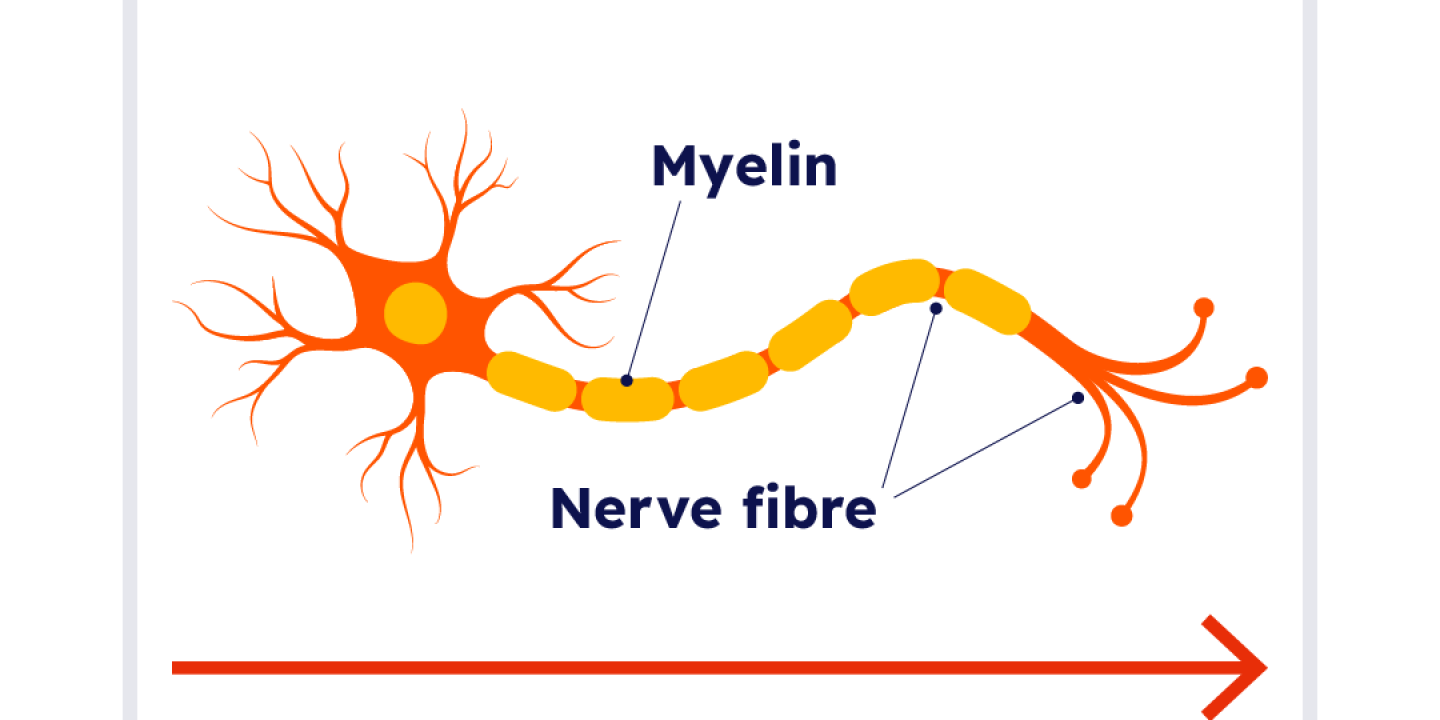
Nerve cells carry messages between the brain and spinal cord and the organs and limbs of the body. They control everything we do – from how we move to how we think and feel.
What is myelin?
Myelin is the fatty protective coating that surrounds nerve fibres - a bit like the insulation on an electrical wire.
What is the function of the myelin sheath?
The function of the myelin sheath is to protect the fragile nerve fibres, and allow messages to travel quickly along the nerves without being lost or interrupted.
For example, in the nerve cells that extend from the spinal cord to the muscles in your leg, the myelin coating allows messages to travel at up to 268 miles per hour. In nerve cells without myelin, the speed the message travels at can drop as low as 1 mile per hour.
What happens to myelin in MS?
In MS, immune cells enter the brain and spinal cord and attack both the myelin and the cells that make it. When myelin becomes damaged, messages find it harder to get through – or can’t get through at all. That’s what causes the symptoms of MS.
These symptoms can be very different for people, depending on where in the brain and spinal cord the attack has occurred.
Why do we need to repair myelin?
If myelin isn't repaired properly, the nerve fibres become increasingly vulnerable to damage. And over time they may be lost. When this happens, messages can no longer get through and symptoms become permanent.
This gradual, steady accumulation of disability is what we call MS progression. It’s why we need to find ways to put myelin back on nerves, protecting them from damage and getting the messages flowing again.
How can we repair and replace myelin?
The human body has an amazing natural ability to repair myelin and get nerves working properly again.
Myelin is repaired or replaced by special cells in the brain called oligodendrocytes. These cells are made from a type of stem cell found in the brain, called oligodendrocyte precursor cells (OPCs).
- Nerve cells signal for help when their myelin is damaged
- When the signal reaches the OPCs, they travel to the site of damage and mature into oligodendrocytes
- And then the damage can be repaired.
Early in the condition, this process works quite well. With the myelin replaced, the messages are able to travel down the nerve fibre again. Your MS symptoms may lessen or go away as the immune attack subsides.
But, with age and repeated attacks, this process stops working as effectively. It’s thought that OPCs stop responding to the nerve cell’s cry for help, and damaged oligodendrocytes can no longer effectively replace the lost myelin.
We need to find ways to kickstart this natural process again. This involves understanding everything about the process: from how nerve cells signal for help, to finding out what molecules help activate the myelin-making cells. Researchers then have to translate these findings into developing treatments that will help people with both relapsing and progressive MS.
This is no small task but we’re making good progress.
Our myelin repair research
With your help, we’re supporting world leading research into myelin repair for MS. This includes funding two dedicated centres of excellence and dozens of individual projects around the UK.
Read about all our current research projects
The MS Society Cambridge Centre for Myelin Repair is dedicated to understanding more about the myelin repair process, particularly focusing on the OPC response. The team are taking a ground-breaking approach to studying myelin repair, for the first time looking at the impact ageing and lifestyle factors (such as diet and exercise) can have on these OPCs.
The MS Society Edinburgh Centre for MS Research is using pioneering animal and tissue models to find the myelin repair treatments of tomorrow. The centre’s expertise includes screening drugs for their potential to help myelin repair and protect nerves from damage. Many researchers there also work closely with people living with MS attending their neurology clinics.
Working together, our Cambridge and Edinburgh centres have created a world-class research environment in which to understand myelin repair and identify drug targets for further testing. Recent breakthroughs include identifying molecules that are important in myelin repair and testing drugs that can target those molecules in clinical trials. And last year researchers found that the diabetes drug metformin could repair myelin in rats. Now we're supporting a trial to test the drug on people with relapsing MS. We hope to hear results in late 2025.
You may also be interested in